


Festive Shopping Budget 2026: How to Prioritise Purchases and Avoid Overspending
- 01 Nov 2026
-
 By Varun Sharma
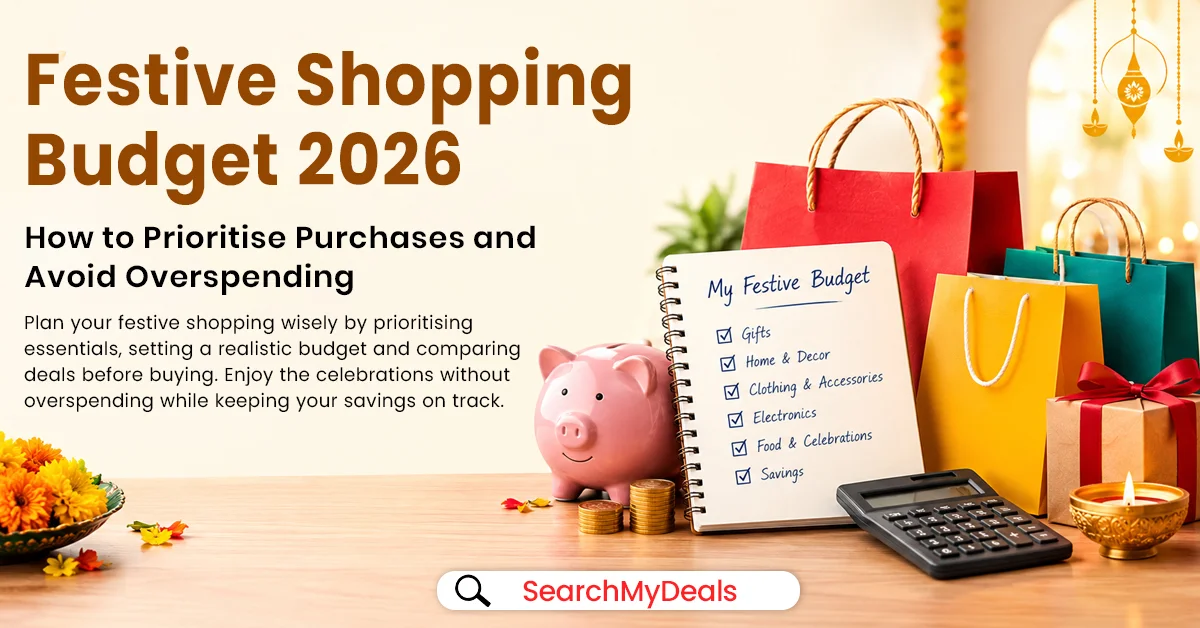
Festive sales can make almost everything look like a bargain. Smartphones, appliances, clothing, home décor, kitchen essentials and gifts all compete for attention through countdowns, limited-time offers and large discount labels. The challenge is not finding something to buy; it is deciding what is genuinely worth buying.
A sensible festive shopping budget 2026 starts before you open a shopping app. Decide how much you can comfortably spend, identify the purchases that matter, and compare the final payable price rather than relying on the advertised discount. A product marked down by 40% is not automatically a good deal if you did not need it or can find the same model for less elsewhere.
This guide explains how to plan festive spending, compare online sale prices, understand coupon and payment offers, and avoid impulse buying. The aim is not to stop you from enjoying festive shopping. It is to help you spend on the right things without creating unnecessary financial pressure afterwards.
1. Build a Festive Shopping Budget Before Browsing
The easiest way to overspend is to shop without a fixed limit. A few small purchases can add up quickly, especially when several websites are running separate sales. Start with an amount that fits your finances rather than estimating your budget from the discounts available.
Separate needs, planned purchases and optional wants
Make three lists before the sale begins:
Essential purchases: Items you genuinely need, such as a replacement appliance, household supplies or clothing for a specific occasion.
Planned purchases: Items you have been considering for some time and can afford, such as a phone upgrade or a useful kitchen appliance.
Optional purchases: Extra décor, accessories, gadgets or gifts that would be nice to have but are not necessary.
This classification helps you make decisions when attractive offers appear. If an optional item consumes money reserved for an essential purchase, it should usually wait.
Allocate money by category
A festive shopping budget planner can be as simple as a spreadsheet or a note on your phone. Divide your available amount into categories such as:
| Category | Example allocation |
|---|---|
| Essential household purchases | 35% |
| Clothing and personal shopping | 20% |
| Gifts and family purchases | 20% |
| Festive décor and food | 10% |
| Flexible reserve | 15% |
These percentages are only an example. Adjust them to your household's needs. Someone planning to buy a refrigerator may allocate more to appliances, while someone with no major purchases planned may keep more money for gifts and celebrations.
The reserve is important. It gives you room for a genuine requirement or an unexpected expense without immediately increasing the overall budget.
Set a maximum price for expensive purchases
For a phone, television, washing machine or other major purchase, decide your maximum acceptable price in advance. Include delivery, installation, accessories and any other unavoidable charges.
If the final amount is above your limit, do not let a limited-time banner make the decision for you. Compare another seller, consider a different model or wait for another sale.
2. How to Compare Online Sale Prices and Calculate the Effective Price
The advertised price is only the starting point. To understand whether an offer is worthwhile, compare the amount you will actually pay after eligible discounts and charges.
Use the final-price formula
A simple way to calculate the effective sale price is:
Effective price = Listed selling price − instant discounts − eligible coupon discounts − eligible bank discounts + delivery or other unavoidable charges
Cashback should be considered separately unless it is immediate and guaranteed under the offer terms. If it is credited later, it does not reduce the amount you need to pay at checkout.
Example:
Suppose an appliance has a listed selling price of ₹30,000.
| Price component | Amount |
|---|---|
| Listed selling price | ₹30,000 |
| Instant seller discount | −₹3,000 |
| Eligible coupon discount | −₹1,000 |
| Eligible bank discount | −₹2,000 |
| Delivery charge | +₹300 |
| Final checkout amount | ₹24,300 |
If the offer also promises ₹1,000 cashback after the transaction, the potential net cost may become ₹23,300—but only if you meet every condition and the cashback is successfully credited.
For budgeting purposes, keep ₹24,300 as the amount you must be able to pay. Treat the future cashback as a possible additional benefit, not money already saved.
Compare the same product, not just similar-looking listings
When comparing prices across retailers, verify the exact model number, storage capacity, colour, size, variant and included accessories. Two products may look identical in photographs but have different specifications or model numbers.
For appliances and electronics, also compare:
Warranty coverage and who provides after-sales service.
Installation or delivery charges.
Included accessories and bundled items.
Seller identity and return or replacement conditions.
Whether the listed model is the latest or an older variant.
A lower price is not necessarily better value if the listing is for a different configuration or has less favourable service conditions.
Check the price history where possible
If you have been planning a purchase, note its price before the sale. Compare the festive price with the product's earlier selling price and other reputable retailers.
A percentage discount against a printed MRP does not tell you how much you are saving compared with the price at which the product is normally available. Your useful comparison is the actual selling price for the same variant.
3. Bank Offers vs Cashback: Read the Conditions Before Paying
Payment offers can reduce the final cost, but the terms often determine whether you qualify. A discount advertised on a product page may apply only to selected cards, minimum transaction amounts, specific payment methods or a limited number of transactions.
Understand the difference
Instant bank discount: The eligible discount is deducted during checkout or reflected in the transaction amount, subject to the offer terms. It is usually easier to account for in your immediate budget.
Cashback: A qualifying amount is credited later to a card, bank account, wallet or other eligible payment method. It may have a maximum cap, crediting timeline and eligibility conditions.
Coupon discount: A code or automatically applied coupon reduces the price if the product, seller, account and order meet the conditions.
Exchange offer: The final benefit depends on the old product's eligibility and condition, inspection and the exchange value offered. The advertised maximum is not a guaranteed amount for every customer.
Questions to check before using a bank offer
Is the offer valid on your exact card type and issuing bank?
Does it require a credit card, debit card, EMI transaction or a particular payment method?
Is there a minimum purchase amount?
What is the maximum discount or cashback cap?
Does the offer apply to the product's listed price or only to an eligible transaction value?
Is the offer limited to selected sellers, models or categories?
Can it be combined with coupons or other discounts?
Are there exclusions for certain EMI plans or payment methods?
Do not assume that every advertised offer can be combined. Some promotions are mutually exclusive, and the checkout page may apply only one eligible benefit.
Evaluate EMI and exchange offers carefully
A no-cost EMI promotion may still involve processing fees, taxes or other charges. Check the total amount payable across all instalments and compare it with the one-time payment price.
For exchange offers, use a realistic estimate for your old device rather than the highest advertised exchange value. The final exchange amount may change after the device is inspected. Also consider whether you are comfortable handing over the old product and whether you have backed up or removed personal data where applicable.
A deal is useful only when the final terms work for your situation—not simply because the banner displays a large saving.
4. How to Avoid Impulse Buying During Festive Sales
Online sales use countdown timers, limited-stock messages, app notifications and personalised recommendations to encourage quick decisions. Some offers are genuinely time-limited, but urgency should not replace basic buying judgement.
Try these practical habits:
Use a 24-hour pause: For non-essential purchases, add the item to your wishlist and review it the next day. If it still fits your budget and needs, compare the offer again.
Shop with a list: Write down the product category, preferred specifications and maximum price before browsing.
Avoid buying only to unlock a discount: Spending another ₹2,000 to qualify for a ₹500 coupon is not a saving if the additional item was unnecessary.
Do not treat the MRP as your target price: A large discount from an inflated or rarely used reference price may not represent a meaningful deal.
Limit duplicate purchases: Check what you already own before buying another kitchen gadget, accessory or décor item.
Keep separate budgets for different people: Gift spending can grow quickly when you buy without setting a per-person limit.
Review your cart before payment: Remove items that were added out of curiosity or because of a recommendation.
Do not borrow for optional sale purchases: Avoid taking on costly debt simply to take advantage of a festive promotion.
A useful test is to ask: Would I still consider buying this product if there were no discount banner? If the answer is no, take another look at whether you need it.
5. Your 2026 Festive Shopping Checklist: Spend Better, Not Just Less
A little preparation can make shopping more efficient and reduce last-minute decisions. Use this checklist before placing an order.
Before the sale
Fix an overall festive spending limit.
List essential and planned purchases separately from optional wants.
Research the exact product model and its usual selling price.
Set a maximum acceptable price for major purchases.
Decide how much you can spend on gifts, clothing and décor.
While comparing offers
Compare the same model and variant across retailers.
Calculate the final checkout amount after eligible discounts and charges.
Read coupon conditions and minimum order requirements.
Check bank-offer eligibility, caps and exclusions.
Treat delayed cashback as a future benefit, not an instant discount.
Estimate exchange value conservatively.
Check delivery, installation, warranty and return conditions.
Before completing payment
Confirm the correct model, size, colour and seller.
Review the final order summary and payment amount.
Check whether an EMI plan adds fees or interest.
Remove optional items that push you beyond your budget.
Save the order confirmation and relevant offer terms.
A simple festive budget tracker
You can use the following format in a spreadsheet:
| Purchase | Budget limit | Final checkout price | Decision |
|---|---|---|---|
| Household appliance | ₹25,000 | ₹23,500 | Within budget |
| Clothing | ₹5,000 | ₹4,200 | Within budget |
| Gifts | ₹6,000 | ₹6,500 | Review |
| Décor | ₹2,000 | ₹1,400 | Within budget |
The example shows why tracking the total matters. Even if most purchases are below budget, one category can exceed its limit. You can then adjust optional spending elsewhere instead of increasing the overall amount automatically.
Frequently Asked Questions
1. How much should I spend during festive sales?
There is no single ideal amount. Set a limit based on your disposable income, essential expenses, existing savings commitments and planned purchases. Avoid using emergency savings or borrowing for optional shopping.
2. How can I tell whether an online festive discount is genuine?
Compare the exact product and model across reputable sellers, check its earlier selling price where reliable price-history information is available, and calculate the final checkout amount. Do not rely only on the discount percentage against MRP.
3. Is cashback better than an instant bank discount?
Not always. An instant discount reduces the amount payable immediately. Cashback may be useful, but it can have eligibility conditions, a crediting delay and a maximum cap. Compare the actual terms and do not count uncertain cashback as money already saved.
4. Should I wait for a bigger festive sale before buying?
Wait if the purchase is optional and you have reason to expect a better price. If the item is essential and the current final price is within your target, a suitable offer may be more valuable than waiting for an uncertain discount.
Shop Smarter with SearchMyDeals
A successful festive shopping season is not measured by the number of orders or the total discount displayed on your screen. It is about buying what you need at a price you can afford, while keeping enough room in your budget for the rest of the celebrations.
Before your next purchase, compare the final price, read the offer conditions and check whether the product belongs on your list. Explore product guides, shopping comparisons and festive offers on SearchMyDeals.com to make more informed buying decisions.


