


Best Air Purifier for Home in India: CADR, Room Size and Filters Explained
- 31 Oct 2026
-
 By Varun Sharma
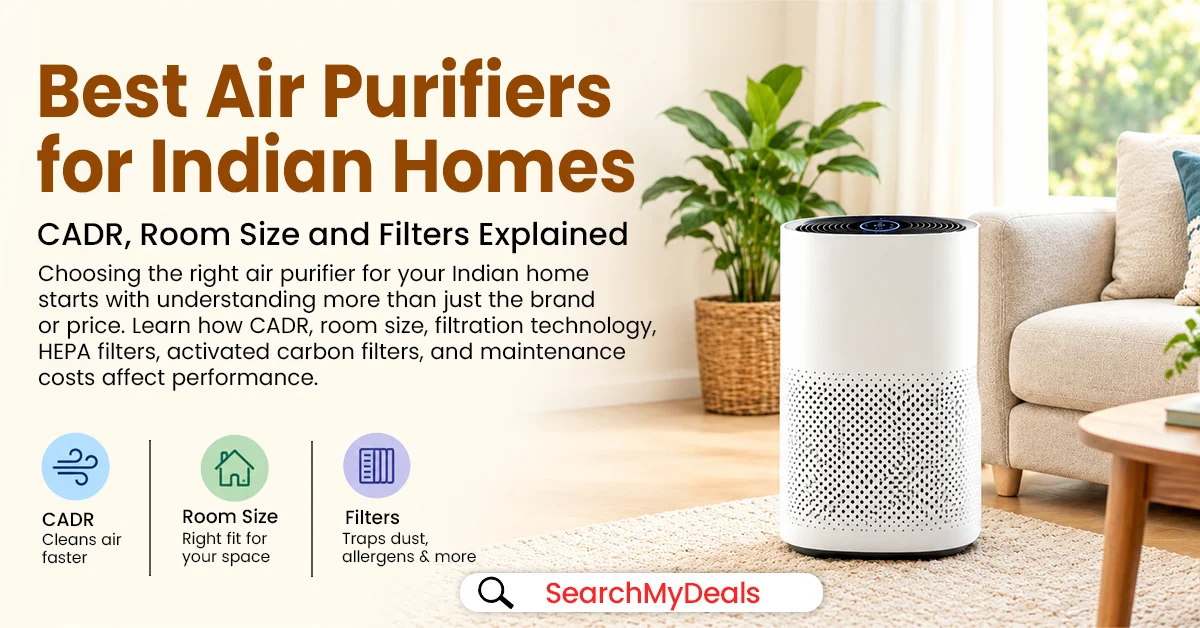
Buying an air purifier for an Indian home is not simply about choosing a popular brand or a model that claims to cover a large area. A purifier that is too small for your room may struggle to circulate and clean enough air, while an expensive model with features you rarely use may not offer good value. The important factors are its clean-air delivery rate (CADR), the size and height of your room, the type of filter, operating noise and the cost of replacement filters.
If you are comparing the best air purifier for home in India, start by identifying where you will use it. A compact bedroom, a large living room and an open-plan dining area have different air-cleaning requirements. You should also consider how often the purifier will run, whether replacement filters are readily available and whether its noise level is acceptable at night.
This guide explains the essentials in straightforward terms and highlights ten air purifier options available through Amazon.in listings for further comparison.
1. CADR Meaning in Air Purifiers: How Much Clean Air Do You Need?
CADR stands for Clean Air Delivery Rate. It indicates how much filtered, cleaner air an air purifier delivers over a given period. It is generally expressed in cubic metres per hour (m³/h) or cubic feet per minute (CFM).
In simple terms, a higher CADR generally means that a purifier can deliver more clean air and is suitable for a larger room, assuming comparable testing and operating conditions. It is one of the most useful figures to check when comparing two models.
However, CADR should not be considered in isolation. Check whether the figure refers to smoke, dust or pollen, which testing method is used, and the fan speed at which the result is achieved. A high figure measured at maximum speed may come with more noise than you would prefer for everyday use.
How to match CADR with room size
First calculate your room's approximate volume:
Room volume = Length × Width × Ceiling height
Use metres for all three measurements to get the volume in cubic metres.
Then use this practical planning formula:
Required clean-air delivery rate = Room volume × Desired air changes per hour
For example, consider a bedroom measuring 12 ft × 12 ft with a 10 ft ceiling. Its approximate volume is 40.8 cubic metres. If you use four air changes per hour as a planning target, the required clean-air delivery rate is approximately:
40.8 × 4 = 163 m³/h
For a larger living room measuring 15 ft × 18 ft with the same ceiling height, the volume is approximately 76.5 cubic metres. At four air changes per hour, the planning figure becomes approximately:
76.5 × 4 = 306 m³/h
These are illustrative calculations, not a universal health standard or a guarantee of actual room performance. Real results depend on the purifier's airflow, filter condition, room layout, doors and windows, air leakage and pollutant sources.
When comparing models, use the manufacturer's stated CADR and room-size guidance. If the room has a high ceiling or connects to other spaces, consider the larger effective area. For an open-plan living and dining area, do not size the purifier only for the smaller seating section.
2. HEPA Filters, Activated Carbon and Other Filtration Technologies
A purifier's filter system determines which types of pollutants it is designed to capture. Many household models combine several filtration stages, but more stages do not automatically mean better performance.
HEPA filter air purifiers
A HEPA filter is designed to capture very small airborne particles. It is commonly used in air purifiers intended to reduce particles such as dust, pollen and other fine particulate matter.
When comparing a HEPA filter air purifier, look for clear information about the filter grade, replacement availability and the manufacturer's stated performance. Terms such as "HEPA-type", "HEPA-like" and "True HEPA" should not be treated as interchangeable without checking the actual technical details.
A well-sized purifier with a suitable particle filter can help reduce airborne particles in the room. It does not, however, remove every pollutant or prevent new particles from entering.
Activated carbon filters
Activated carbon is used to adsorb certain gases and odours. It can be useful when a purifier is intended to address cooking smells or some gaseous pollutants.
The amount and quality of carbon matter. A thin carbon-coated sheet may not have the same capacity as a substantial carbon bed. Also, CADR ratings generally measure particle removal, not the performance of gas-removal filters.
If odour or gaseous pollutants are a concern, check what the manufacturer specifically claims the carbon filter is designed to address. Do not assume that every carbon filter removes all VOCs or household gases.
Pre-filters and other stages
A washable or cleanable pre-filter can capture larger particles such as hair, lint and visible dust before they reach the main filter. This may help protect the primary filter, but it does not replace HEPA filtration.
Some models also advertise UV, ionisation or other additional technologies. Treat these as separate features rather than proof of superior air cleaning. Avoid devices that intentionally generate ozone; ozone can irritate the respiratory system.
For most household buyers, a properly sized particle-filtering purifier, a clearly specified filter system and accessible replacement filters are more important than a long list of marketing terms.
3. Best Air Purifier for Bedroom vs Living Room: What Should You Compare?
The best air purifier for a bedroom may not be the right choice for a large living room. Apart from CADR and coverage, consider how and when you will use it.
Choosing an air purifier for a bedroom
A bedroom purifier should be appropriately sized for the room while remaining comfortable to operate during sleeping hours.
Look for:
A low-noise or sleep mode with a clearly stated decibel rating.
A CADR suitable for the bedroom, not merely a small personal-use area.
Dimmable or switchable display lights if you prefer a dark room.
A filter replacement indicator or clear maintenance instructions.
A compact design that can be placed without blocking airflow.
One important point: sleep mode usually reduces fan speed. That can also reduce the amount of air filtered. Check whether the purifier can still provide useful airflow at the setting you are likely to use overnight.
Choosing an air purifier for a living room
Living rooms are often larger and may connect to balconies, dining areas or corridors. They may also have more movement, open doors and changing sources of dust and cooking odours.
Consider a model with a higher CADR and a room-size recommendation that matches the full area you want to serve. Air-quality sensors, automatic mode and app controls can be convenient, but they should not replace checking the purifier's actual filtration performance.
Why noise levels deserve attention
A purifier that is too noisy may be switched off frequently. Compare the noise rating across operating modes rather than looking only at the lowest advertised number.
If a manufacturer provides a range in decibels (dB), check which speed each number represents. A quiet setting may be suitable for sleeping, while a higher speed may be more useful when the room needs faster particle removal.
4. Air Purifier Filter Replacement Cost: The Ownership Expense Many Buyers Miss
The purchase price is only part of the cost of owning an air purifier. Replacement filters can make a noticeable difference to the total expense over two or three years.
Before buying, search for the exact replacement filter compatible with the model. Do not assume that filters from different models of the same brand will fit.
Compare these details:
Replacement price: Check the current price of the complete compatible filter, not just a pre-filter.
Recommended replacement interval: Follow the manufacturer's guidance. Actual filter life can vary with pollution levels, usage and maintenance.
Availability: Confirm that the replacement filter is available from a reliable seller.
Filter components: Check whether the replacement includes the particle filter and activated carbon layer or whether these are sold separately.
Cleaning requirements: Find out whether the pre-filter can be cleaned and how often this should be done.
Warranty and service: Review the warranty conditions and the manufacturer's support arrangements.
A useful way to compare models is to estimate their annual running cost:
Estimated annual filter cost = Replacement filter price × Expected replacements per year
For example, if a compatible filter costs ₹3,000 and the manufacturer recommends replacing it once a year, the estimated annual filter expense is ₹3,000. This is only an illustration; check the actual filter price and replacement schedule for the model you choose.
Also account for electricity consumption if you intend to run the purifier for long periods. A slightly more expensive model may offer better value if its filters are reasonably priced and easy to obtain.
5. Ten Air Purifiers to Compare on Amazon.in
The following products provide a starting shortlist across compact bedrooms, medium-sized rooms and larger living spaces. They are not presented as independently tested rankings. Model variants, prices, availability and specifications can change, so check the current listing and manufacturer's product information before buying.
1. Qubo Smart Air Purifier Q200
A compact option to investigate for smaller rooms. Check its stated coverage, CADR and replacement-filter price before deciding whether it suits your bedroom.

2. Qubo R250 Smart Air Purifier
A bedroom-oriented model worth comparing if you want a compact purifier with smart features. Verify the room-size guidance and noise level at the operating speed you expect to use.

3. Eureka Forbes Air Purifier 355
A model to consider when comparing mid-range household purifiers. Check the manufacturer's filter details, recommended room size and compatible replacement filter.

4. Philips PureProtect 3200 Series Smart Air Purifier
A smart purifier option for buyers comparing sensor features, filtration and room coverage. Verify the exact model's CADR, filter cost and noise specifications rather than relying on the series name alone.

5. Qubo Smart Air Purifier Q400
A higher-capacity option in the Qubo range to investigate for a larger room. Confirm its coverage claim and compare it with the actual dimensions and ceiling height of your space.

6. Pure Air PA5 Air Purifier for Home
A larger-room candidate for shoppers who want to compare smart controls and higher stated coverage. Check whether the quoted coverage is based on a suitable air-change rate for your needs.
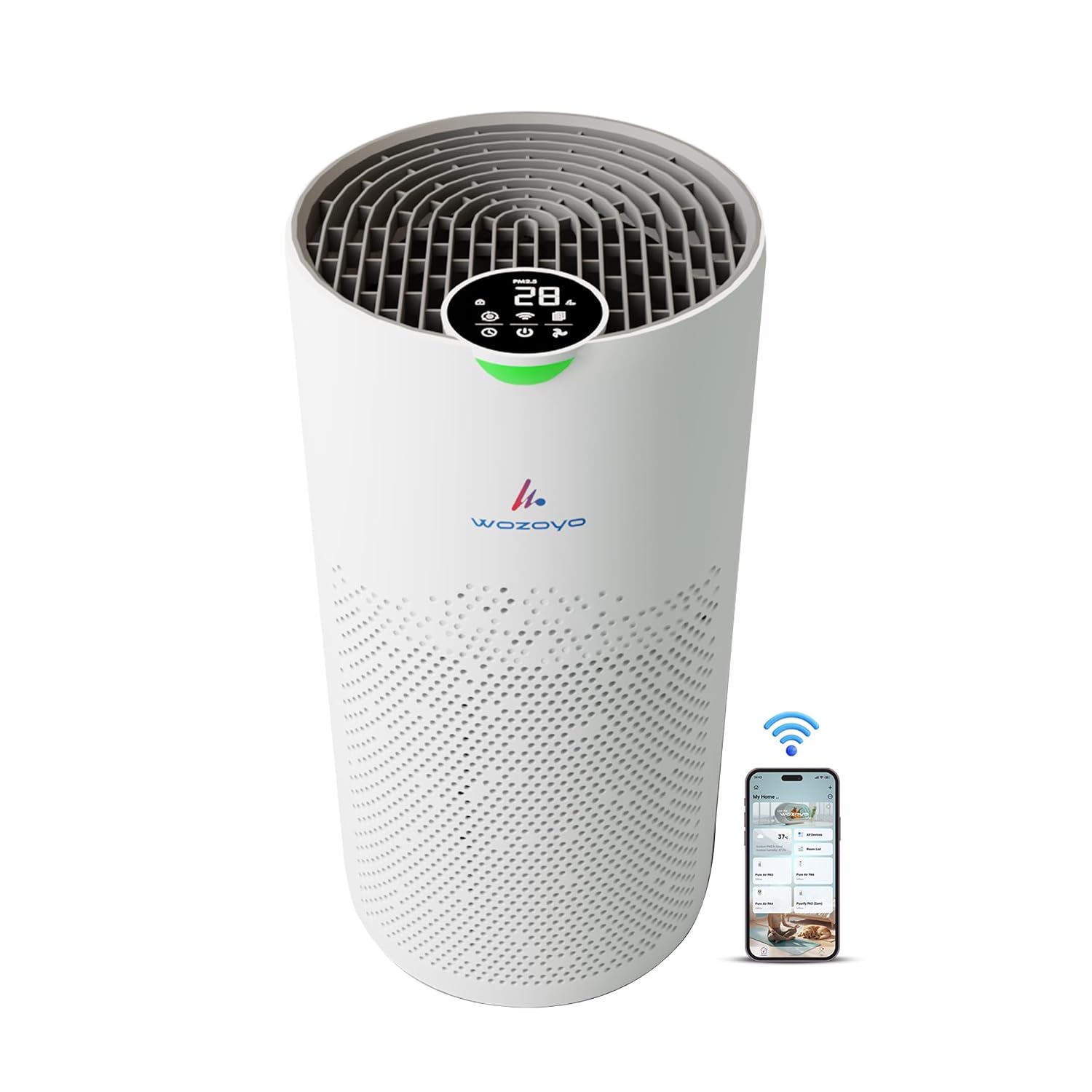
7. Philips Smart Air Purifier – large-room model
Philips has several air purifier models with different room-size and CADR specifications. Confirm the exact model number on the listing and compare its official specifications with the space you intend to clean.

8. Honeywell Air Touch U1
A model worth including in a comparison of larger household purifiers. Check the current product documentation for CADR, filter stages, replacement filter availability and noise levels.

9. Dr Trust USA Zurich Portable Room Air Purifier
A compact household option to investigate. Check the exact filter configuration and independent performance information, especially if the listing uses several filtration or UV-related claims.

10. Eureka Forbes Smart Air Purifier 500
A model to compare for larger spaces. Before buying, verify the manufacturer's stated room coverage, compatible filter price, operating noise and warranty terms.

Frequently Asked Questions
1. What CADR is suitable for a bedroom in India?
It depends on the bedroom's volume, not just its floor area. Multiply the room volume in cubic metres by your chosen air changes per hour to estimate the required CADR in m³/h. Then compare this with the manufacturer's stated performance and room-size guidance.
2. Is a HEPA air purifier enough for smoke and bad odours?
A suitable particle filter can help reduce airborne particles, including some fine particles associated with smoke. Activated carbon may help with certain odours and gases. Neither makes exposure to smoke harmless, and a purifier does not remove every pollutant. Avoid indoor smoke sources and follow appropriate ventilation and source-control practices.
3. How often should an air purifier filter be replaced?
There is no single replacement interval for every purifier. Follow the manufacturer's instructions and consider usage, local pollution and filter-condition indicators. Check the cost and availability of the exact compatible filter before purchasing the machine.
4. Should I run an air purifier all day?
Longer operating time generally allows more air to pass through the filter, but the appropriate setting depends on room conditions, noise and electricity use. Many people prefer continuous operation at a comfortable speed. Keep the purifier's air intake and outlet unobstructed and follow the manual.
Choose the Right Air Purifier with SearchMyDeals
The right air purifier is not necessarily the most expensive or the one with the biggest coverage number. Match its CADR to your room, check filtration details, compare replacement-filter expenses and make sure the noise level is practical for everyday use.
Explore air purifiers and compare available shopping offers on SearchMyDeals.com before making your final choice.
Affiliate disclosure: This article may contain affiliate links. We may earn a commission from qualifying purchases at no additional cost to you.


