


Best Water Purifiers for Indian Homes: RO vs UV vs UF and What to Check Before Buying
- 30 Oct 2026
-
 By Varun Sharma
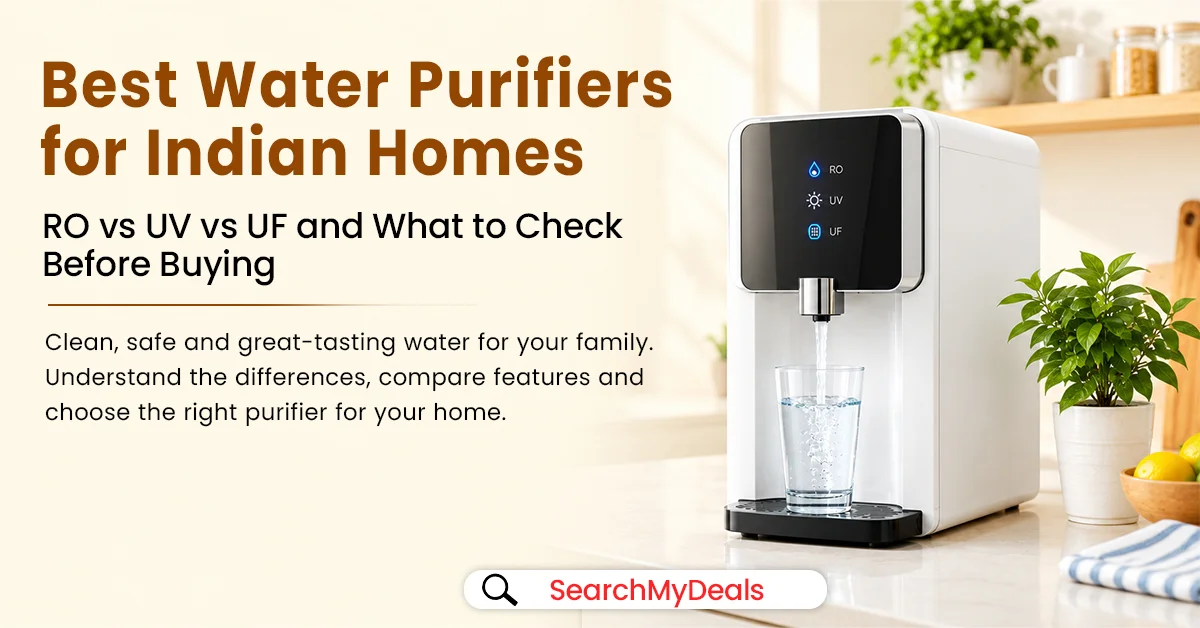
Choosing a water purifier for your home is not simply a matter of picking the model with the most filtration stages. The right choice depends on where your water comes from, what contaminants may be present, how much water your household consumes and how much you are prepared to spend on maintenance.
A home receiving treated municipal water may have different needs from one using borewell water or a private tanker supply. An RO purifier can reduce dissolved salts and certain contaminants, while UV and UF technologies serve different purposes. Buying a system that does more than your water requires can add expense and maintenance without necessarily improving the outcome.
This water purifier buying guide for India explains RO vs UV water purifier options, what to check before buying, and ten models worth investigating on Amazon.in. Use the shortlist as a starting point—not a substitute for water-quality testing or checking the latest product specifications.
1. RO vs UV vs UF: Which Purification Technology Do You Need?
RO: For dissolved impurities where treatment is needed
Reverse osmosis (RO) uses a semi-permeable membrane to reduce many dissolved substances, including salts and certain contaminants. It may be appropriate when testing identifies elevated dissolved solids or specific contaminants that the selected purifier is designed to reduce.
RO systems generally require electricity, periodic filter and membrane replacement, and a way to manage reject water. They can also alter the mineral content of water. A model with a mineraliser or TDS controller should not be treated as a substitute for testing or evidence of purification performance.
Consider RO when: your water-quality report indicates that RO is needed, such as for certain high-TDS supplies or specific dissolved contaminants within the model's stated capabilities.
UV: For microbial inactivation
Ultraviolet (UV) purification uses UV light to inactivate susceptible microorganisms. It does not remove dissolved salts or reduce TDS. Its effectiveness depends on the system design, maintenance and operating conditions; it is not a replacement for addressing chemical contamination.
Consider UV when: the water's chemical quality is suitable for the intended use but microbial risks require treatment, and the system is appropriate for the source water.
UF: For physical filtration
Ultrafiltration (UF) uses a membrane to remove suspended particles and many microorganisms, depending on the membrane's specifications. Conventional UF does not remove dissolved salts in the way RO does. It should not be assumed to make chemically contaminated water safe.
Consider UF when: the water needs appropriate physical filtration and the water-quality assessment supports a non-RO option.
What about RO+UV+UF combinations?
Multi-stage systems combine technologies to address different types of impurities. More stages do not automatically mean better water for every household. Check what each stage does, which contaminants the complete model is tested or certified to reduce, and whether the extra components justify their maintenance cost.
2. Choose According to Your Water Source and Quality
The source of your water is a useful starting point, but it does not tell the whole story. Municipal supplies can vary, tanker water can come from different sources, and borewell water can differ considerably from one location to another.
Municipal water: Start by checking the supplier's water-quality information and, where necessary, obtain a test of the water at your home. If the water is adequately treated and its chemical quality is suitable, a non-RO option may be sufficient for the specific risks identified. Do not buy RO solely because the purifier advertises more stages.
Borewell water: Dissolved salts, hardness, iron, fluoride, nitrate and other parameters may be concerns depending on the location. Test for the relevant chemical parameters rather than relying only on appearance or taste. RO may be appropriate for some findings, but the selected unit must be capable of treating the identified contaminants.
Tanker or mixed-source water: Ask the supplier about the source, but do not rely on that information alone. Quality may change between deliveries. If your building switches between municipal, borewell and tanker supplies, assess the water you actually receive and choose a system that can handle the identified risks.
Hard water: Hardness is mainly associated with dissolved calcium and magnesium. RO can reduce many dissolved minerals, but a purifier should be selected according to the complete water analysis and intended drinking-water use. A TDS reading alone cannot tell you which dissolved substances are present.
A TDS meter measures the total concentration of dissolved substances approximately; it does not identify individual contaminants or establish microbiological safety. Water with a low TDS reading is not automatically safe, and a high reading does not identify the exact treatment needed.
Where safety is uncertain, arrange testing through an appropriate water-testing laboratory. In India, the Bureau of Indian Standards' IS 10500 drinking-water specification is an important reference for drinking-water quality. Match the purifier's documented treatment capabilities to the test results, and seek qualified advice if the report identifies a specific contaminant.
3. Ten Water Purifiers to Compare on Amazon.in
These ten models cover different combinations of RO, UV, UF, storage and additional treatment stages. They are a research shortlist, not a universal ranking. Amazon.in listings, exact variants, prices, installation terms and availability can change, so verify the live listing and manufacturer's specifications before purchasing.
For RO-based purification
1. Aquaguard Delight Aquasaver RO+UV+UF
A model to investigate if your water assessment supports RO and you want a multi-stage system. Compare the stated water-recovery performance, tank capacity, filter replacement costs and service coverage in your PIN code.

2. KENT Grand RO
Worth comparing for households considering an RO system with additional filtration stages and storage. Verify the precise model version, TDS-control features, warranty and what the first-year service package includes.

3. Livpure GLO PRO++ RO+UV+UF
A value-oriented model to compare when you need multiple purification stages. Check the current price, filter life, installation conditions and the cost of consumables after any included service period.

4. V-Guard Zenora RO
An RO option to investigate if testing indicates that reverse osmosis is appropriate. Compare the unit's stated source-water limits, storage capacity, service availability and replacement-filter pricing.

5. Pureit Eco Water Saver
Consider this model when comparing RO-based purification and water-recovery claims. Check the exact variant and independently verify the manufacturer's stated recovery rate, filter costs and warranty terms rather than relying on a headline saving claim.

For other needs and feature comparisons
6. KENT Ultra Storage UV+UF
A non-RO option to investigate for suitable water supplies where dissolved contaminants do not require RO treatment. Confirm the model's actual UV and UF configuration, source-water suitability and maintenance instructions.

7. Aquaguard Sure Delight UV+UF
Worth checking if you are comparing a UV+UF system for water whose chemical quality has already been assessed. Confirm the exact model because similarly named products may use different technologies.
8. AO Smith X2 UV+UF
A model to investigate for a compact non-RO installation where the incoming water is suitable for this treatment approach. Check installation requirements, storage capacity and the manufacturer's contaminant-reduction specifications.

9. Pureit Classic 23L gravity purifier
A gravity-based option to research where electricity-free operation is useful and the source water is suitable for the particular product. Do not assume that a gravity purifier can handle high dissolved solids or every chemical and microbial risk.

10. Urban Company Native M1 RO+UV
A model to compare if RO is indicated and you are evaluating service or filter-package offerings. Read the current terms carefully: understand what is included, how long coverage lasts and what charges may apply afterward.

Product-link note: The names above are models to investigate, not confirmation that every exact variant is currently available on Amazon.in. Replace the placeholders with verified product-specific Amazon.in pages and your own affiliate tracking URLs before publication. Do not publish unverified prices or offer claims.
4. Look Beyond the Purchase Price: Maintenance, Filters and Service
The upfront price is only one part of a purifier's cost. Filter replacements, RO membranes, UV lamps where applicable, technician visits and any annual maintenance contract (AMC) can change the long-term value substantially.
Before buying, ask the seller or manufacturer:
What is included initially? Check whether installation, pre-filters, a first service visit or replacement consumables are included.
How often must filters be changed? Replacement intervals depend on the model, usage and incoming water quality. Follow the manufacturer's schedule and any relevant service alerts.
What is the recurring cost? Request a current price list for filters, membranes, UV lamps and service visits. Do not assume an advertised multi-year package covers every component or every type of repair.
Is service available locally? Check whether authorised technicians cover your PIN code, what response times are offered and whether the warranty excludes consumables.
How much water is rejected? RO systems produce reject water. Compare the manufacturer's stated recovery performance under its specified conditions, and plan a safe, practical use for reject water where appropriate. Do not assume every model's water-saving claim is directly comparable.
Also consider storage capacity, daily household demand, installation space, electricity requirements and whether the purifier continues to dispense stored water during a power cut. A larger tank can be convenient, but it does not compensate for an unsuitable treatment method or neglected maintenance.
5. A Practical Buying Checklist and FAQs
Before ordering a water purifier, use this checklist:
Get a water-quality assessment appropriate to your source and local risks.
Match the technology to the contaminants identified, not simply to the TDS number.
Verify the exact model and its documented treatment capabilities.
Compare filter and membrane replacement costs, service charges and warranty exclusions.
Confirm authorised service availability in your area.
Review the Amazon.in seller, installation conditions, return terms and current price.
Follow the manufacturer's maintenance instructions after installation.
Frequently Asked Questions
1. Is RO necessary for every Indian home?
No. RO is not automatically necessary for every water supply. The right technology depends on the water-quality assessment and the contaminants that need to be addressed.
2. Is UV better than RO?
Neither is universally better. UV inactivates susceptible microorganisms but does not remove dissolved salts; RO reduces many dissolved substances and certain contaminants. Select based on the risks identified in your water.
3. Can a TDS meter tell me whether water is safe to drink?
No. TDS is only one measurement and does not identify individual chemicals or show whether harmful microorganisms are present. Use appropriate laboratory testing when safety is uncertain.
4. How much does water purifier maintenance cost each year?
There is no single reliable annual figure for every model. Costs depend on the purifier, source-water quality, household consumption, filter life, service plan and local charges. Ask for current replacement-part and service prices before buying.
Choose the Right Purifier, Not Just the Most Expensive One
The best water purifier is the one that addresses your household's actual water-quality needs, can be maintained properly and has reliable service support. Test first where necessary, compare the complete cost of ownership and verify the product's capabilities before committing.
Explore SearchMyDeals.com for water purifier comparisons, product information and relevant festive offers. Check current listing details and service terms before making your final choice.
Affiliate disclosure: This article may contain affiliate links. We may earn a commission from qualifying purchases at no additional cost to you.


