


Best Power Bank in India: Capacity, Fast Charging and Buying Guide
- 18 Nov 2026
-
 By Varun Sharma
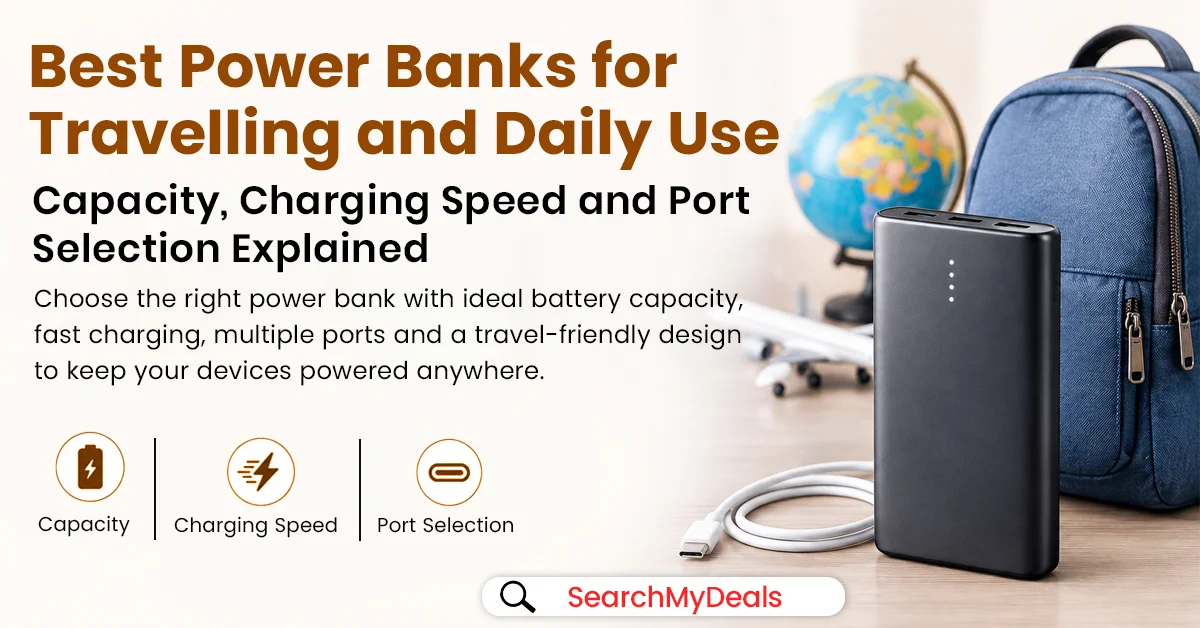
A smartphone running out of battery during a long journey, an important office call or a day spent travelling between meetings can be more than an inconvenience. A reliable power bank helps keep your devices charged when a wall socket is unavailable. However, choosing one is not simply about buying the model with the highest mAh rating.
Capacity, actual usable output, charging speed, supported charging protocols, port selection and portability all affect how useful a power bank will be. A lightweight 10,000mAh model may be sufficient for everyday smartphone use, while a 20,000mAh power bank can be more practical for frequent travellers or people carrying multiple devices.
If you are looking for the best power bank in India, this guide explains the specifications that matter, compares different capacity options and highlights products worth exploring on Amazon.in. It also covers airline travel considerations so that you can choose a suitable model before your next trip.
1. Understanding Power Bank Capacity: 10000mAh vs 20000mAh
Capacity is usually the first specification shoppers notice. Most power banks sold in India advertise capacities such as 5,000mAh, 10,000mAh, 20,000mAh and 30,000mAh.
A higher mAh rating generally means more stored energy, but it does not translate directly into the same amount of charge delivered to your phone.
How Much Usable Capacity Do You Actually Get?
Power banks contain lithium-ion or lithium-polymer battery cells. Their internal cells operate at a nominal voltage, commonly around 3.7V, while USB output is typically delivered at 5V or higher.
Energy is therefore better compared using watt-hours (Wh) rather than mAh alone.
For example:
A 10,000mAh power bank at a nominal 3.7V stores approximately 37Wh.
A 20,000mAh power bank at the same nominal voltage stores approximately 74Wh.
When energy is converted to USB output, some is lost through voltage conversion, heat and charging inefficiencies. Additional losses occur inside the phone during battery charging.
This means a 10,000mAh power bank will not necessarily provide two complete charges to every smartphone with a 5,000mAh battery.
Actual results depend on the power bank's conversion efficiency, the phone's battery characteristics, charging speed, cable quality and operating conditions.
Which Capacity Should You Choose?
| Capacity | Best suited for | Main advantage | Limitation |
|---|---|---|---|
| 5,000mAh | Emergency backup | Very compact | Limited reserve |
| 10,000mAh | Daily commuting | Portable and convenient | Less suitable for multiple devices |
| 20,000mAh | Travel and work | Larger energy reserve | Heavier and bulkier |
| 27,000mAh | Extended travel and device charging | High stored energy | Requires careful airline Wh checking |
10,000mAh Power Bank: For Everyday Use
A 10000mAh power bank is a practical option for people who primarily need smartphone backup during office hours, commuting or short outings.
Consider it if:
You carry one smartphone.
You prefer a lightweight accessory.
You need occasional top-ups rather than repeated full charges.
You want something that fits easily into a small bag or backpack.
20,000mAh Power Bank: For Frequent Travellers
A 20000mAh power bank offers more stored energy and is generally better suited to longer journeys.
It can be useful when carrying:
A smartphone and wireless earbuds.
Multiple smartphones.
A tablet or other compatible USB-powered device.
Devices that need charging during long working days.
However, compare the weight and dimensions before purchasing. A higher-capacity model may be less convenient if you carry it every day.
2. Charging Speed and USB-C PD: What Do the Wattage Numbers Mean?
Capacity determines how much energy a power bank stores, while wattage indicates how quickly it can deliver power to a connected device.
A fast charging power bank can save considerable time, particularly when you have a short break between meetings or need to charge your phone before boarding a train or flight.
Understanding Charging Wattage
Power banks commonly advertise output ratings such as 12W, 18W, 20W, 22.5W, 30W, 33W, 45W and 65W.
Here is a general comparison:
| Maximum output | Typical use |
|---|---|
| 10W–12W | Basic smartphone charging |
| 18W–20W | Faster charging for compatible smartphones |
| 22.5W–30W | Fast charging for many compatible phones |
| 33W–45W | Higher-speed smartphone and selected tablet charging |
| 65W and above | Compatible laptops, tablets and smartphones |
These are indicative power categories, not guaranteed charging speeds. Actual performance depends on the device, charging protocol, cable and power bank's output configuration.
What Is USB-C Power Delivery (PD)?
USB-C Power Delivery is a charging protocol that allows compatible devices and chargers to negotiate suitable voltage and current levels.
A USB-C connector alone does not guarantee USB PD support. This is an important distinction when shopping for a power bank.
Check for:
USB-C input and output rather than input-only Type-C ports.
Explicit USB PD support in the specifications.
Supported voltage and wattage combinations.
Compatibility with your smartphone, tablet or laptop.
A suitable USB-C cable rated for the required power.
The USB Implementers Forum explains that USB Type-C and USB Power Delivery are separate specifications. Therefore, do not assume that every Type-C power bank supports fast charging.
PD, PPS and Quick Charge: Which Should You Look For?
You may encounter several charging standards when comparing power banks.
| Technology | What it does | What to check |
|---|---|---|
| USB PD | Negotiates power delivery between compatible devices | Device and power bank support |
| PPS | Allows compatible devices to adjust charging voltage dynamically | Explicit PPS compatibility |
| Quick Charge (QC) | Qualcomm's fast-charging technology | Supported QC version |
| Proprietary fast charging | Brand-specific charging systems | Exact smartphone compatibility |
For professionals carrying different devices, USB-C PD is a useful feature to prioritise. If you own a Samsung smartphone that supports PPS, check for PPS compatibility as well.
For Xiaomi, OnePlus, OPPO and other smartphone brands, advertised proprietary charging speeds may require specific protocols and compatible cables. A power bank advertising 33W or 45W may not deliver that maximum speed to every phone.
Can a Power Bank Charge a Laptop?
Some high-output power banks can charge compatible laptops through USB-C PD. However, a high wattage number alone is not sufficient.
Before buying, check:
Your laptop's USB-C charging support.
Its required input wattage.
Whether the power bank supports the required PD voltage profile.
Whether the USB-C port provides the advertised wattage independently.
Whether charging multiple devices reduces the available output.
For a laptop requiring 65W USB-C charging, a 20W or 33W smartphone power bank will generally be inadequate. A 65W or higher PD model may be more appropriate, subject to compatibility.
3. Ports, Cables, Weight and Design: Features That Matter in Daily Use
A power bank can have excellent capacity and charging speed but still be inconvenient if it has the wrong ports or is too heavy to carry.
USB-A vs USB-C Ports
Most modern power banks offer a combination of USB-A and USB-C ports.
USB-A: Useful for older charging cables and accessories.
USB-C: More versatile for newer smartphones, tablets and compatible laptops.
Micro-USB: An older connection that may be available as an input on some budget models.
If you are purchasing a new power bank, prioritise USB-C input and output. A USB-A port is still useful if you regularly charge older devices.
How Many Ports Do You Need?
Your requirements depend on the number of devices you carry.
| Port configuration | Suitable for |
|---|---|
| 1 USB-C | Single-device charging |
| 1 USB-C + 1 USB-A | Smartphone and accessory |
| 1 USB-C + 2 USB-A | Multiple devices |
| Multiple USB-C ports | Newer smartphones, tablets and laptops |
Remember that the advertised maximum output may apply only when one device is connected. When multiple devices are plugged in, the total available power is often shared between ports.
Check the manufacturer's multi-port output table before purchasing.
Built-in Cables vs Separate Cables
Some modern power banks include an integrated USB-C cable or detachable charging cable.
Benefits include:
Fewer accessories to carry.
Convenient charging during commuting.
Reduced chances of forgetting a charging cable.
Easier access when travelling.
However, an integrated cable can become a disadvantage if it gets damaged and cannot be replaced independently.
If you already carry a good USB-C cable, a conventional power bank with standard ports may offer greater flexibility.
Weight and Portability
Weight becomes particularly important when carrying a power bank throughout the day.
A compact 10,000mAh model may be easier to keep in a pocket, whereas a 20,000mAh model generally occupies more space and adds weight to your backpack.
Consider the following:
Daily office commuting: prioritise compact dimensions and manageable weight.
Business travel: consider 10,000mAh or 20,000mAh depending on device requirements.
Long journeys: prioritise capacity, port selection and recharge speed.
Laptop charging: check both wattage and physical size.
Do not compare capacity without comparing weight. A slightly heavier product may be worthwhile if it offers substantially more usable energy or faster charging.
Digital Display and Battery Indicators
Some power banks use four LED indicators, while others include a digital percentage display.
A digital display can help you estimate remaining battery more precisely. Some premium models also show charging wattage.
These are convenience features rather than essential performance requirements. If your budget is limited, prioritise battery capacity, charging compatibility and safety features first.
4. Power Banks for Air Travel: Airline Restrictions and Safety Considerations
If you frequently travel by air, battery capacity is not the only specification to check. Airlines regulate lithium batteries based on their watt-hour rating, and power banks are generally treated as spare batteries.
A common mistake is checking only the mAh number without looking at the Wh rating printed on the product.
Understanding the 100Wh Airline Limit
The basic energy calculation is:
Assuming a nominal battery voltage of 3.7V:
| Advertised capacity | Approximate energy |
|---|---|
| 10,000mAh | 37Wh |
| 20,000mAh | 74Wh |
| 26,800mAh | 99.16Wh |
| 27,000mAh | 99.9Wh |
| 30,000mAh | 111Wh |
These are illustrative calculations. Always use the manufacturer's declared Wh rating, rather than relying solely on the capacity printed in mAh.
Important Airline Rules
According to IATA's 2026 passenger guidance:
Power banks must be carried in cabin baggage, not checked baggage.
Power banks up to 100Wh are generally permitted in cabin baggage, subject to applicable restrictions.
Power banks above 100Wh and up to 160Wh are not permitted as power banks under the 2026 passenger guidance.
A maximum of two power banks per passenger is specified in the guidance.
Power banks should be individually protected against short circuits.
Air India also specifies a maximum of two power banks per passenger and prohibits their use or charging onboard.
There is an additional consideration for passengers departing from India. The Ministry of Civil Aviation confirmed in a March 2026 parliamentary response that the DGCA had issued an advisory on 11 November 2025 advising airlines to prohibit using power banks to charge portable electronic devices during flights.
Practical Travel Precautions
Before travelling:
Keep your power bank in your cabin bag.
Never pack it in checked-in luggage.
Protect exposed connectors and avoid carrying loose damaged cables.
Do not travel with swollen, damaged or overheating power banks.
Keep the printed capacity and Wh information visible.
Check your airline's latest rules before departure.
Do not use or recharge the power bank onboard where prohibited.
A 20,000mAh power bank with a declared 74Wh rating is generally a practical capacity for air travel, subject to airline approval and current restrictions. It offers more stored energy than a 10,000mAh model without crossing the commonly used 100Wh threshold.
For the latest information, consult IATA's lithium battery travel guidance and Air India's restricted baggage policy.
5. Best Power Banks to Compare on Amazon.in, FAQs and Buying Recommendations
The following products cover different requirements, from everyday smartphone charging to higher-capacity travel use. The selection is based on available product listings and published specifications, not independent laboratory testing.
A. Compact Power Banks for Everyday Use
1. Portronics Luxcell 10,000mAh – 22.5W
A 10,000mAh power bank listed with up to 22.5W output. Worth comparing for everyday smartphone charging and commuting.

Why consider it: A compact-capacity option for people who want portable backup without carrying a larger 20,000mAh unit. Check the exact model's USB-C input/output configuration and charging protocols before ordering.
2. Philips DLP1711NB/94 – 10,000mAh, 22.5W
A 10,000mAh power bank listing advertising up to 22.5W fast charging and a digital LED display.

Why consider it: Worth comparing if you prefer a digital battery-level display alongside a compact battery capacity. Confirm the port configuration, supported fast-charging protocols and warranty for the selected listing.
B. Higher-Capacity Power Banks for Travel
3. boAt EnergyShroom PB435 Turbo – 20,000mAh, 35W
A 20,000mAh model advertised with up to 35W charging output. A candidate for users who need a larger energy reserve and faster charging.

Why consider it: Its advertised capacity and output make it worth comparing for longer journeys and heavier smartphone usage. Verify the individual USB-C and USB-A output ratings, multi-device power sharing and laptop compatibility before purchase.
4. Xiaomi Power Bank 4i – 20,000mAh, 33W
Includes one USB-C and two USB-A output ports, USB-C input and 12-layer safety protection. Xiaomi specifies a one-year warranty.

Why consider it: A useful comparison for frequent travellers who need more capacity, three output ports and a higher charging output. At 440g, however, it is noticeably heavier than a typical compact 10,000mAh model.
Product comparison at a glance
| Product | Capacity | Advertised maximum output | Best suited for |
|---|---|---|---|
| Portronics Luxcell | 10,000mAh | 22.5W | Daily use |
| Philips DLP1711NB/94 | 10,000mAh | 22.5W | Everyday backup |
| boAt PB435 Turbo | 20,000mAh | 35W | Travel and heavier use |
| Xiaomi Power Bank 4i | 20,000mAh | 33W | Multi-device charging |
The output figures are manufacturer/listing claims and should not be interpreted as guaranteed charging speeds for every connected device.
Frequently Asked Questions (FAQs)
1. Is a 20,000mAh power bank better than a 10,000mAh power bank?
Not necessarily. A 20,000mAh model stores approximately twice the energy of a comparable 10,000mAh model, but it is generally heavier and larger. Choose 10,000mAh for everyday portability and 20,000mAh for longer journeys or multiple devices.
2. Can I carry a 20,000mAh power bank on an aeroplane in India?
Generally, yes, provided its declared energy rating is within the applicable limit and it meets the airline's conditions. A typical 20,000mAh lithium-ion power bank rated at 3.7V is approximately 74Wh. It must be carried in cabin baggage, not checked baggage. Check your airline's latest rules before flying.
3. Can a fast charging power bank damage my smartphone?
A properly designed, compatible power bank negotiates charging power with the connected device. The phone does not automatically receive the maximum wattage advertised on the power bank. Use compatible cables and reputable products with appropriate safety protections.
4. Can I charge my laptop using a 20,000mAh power bank?
Some can, but capacity alone does not determine laptop compatibility. Check for USB-C PD output, the supported voltage profiles and sufficient wattage for your laptop. A 20,000mAh power bank with only 18W output may not be suitable for a laptop requiring 65W charging.
Final Thoughts: Choose a Power Bank That Matches Your Usage
The best power bank is not necessarily the one with the highest capacity or wattage. It is the one that fits your devices, charging requirements and travel habits.
For daily commuting, a 10,000mAh power bank with USB-C PD and a manageable weight can be a sensible purchase. Frequent travellers may prefer a 20,000mAh model with multiple ports and faster recharging. Professionals carrying tablets or compatible laptops should prioritise higher USB-C PD output and check the supported charging profiles.
Before placing an order, compare the advertised capacity, rated energy in Wh, port configuration, actual output specifications, weight, warranty and airline compatibility.
Explore the latest power banks and available shopping offers on SearchMyDeals.com to compare options for daily use, office requirements and travel without paying for specifications you may not need.
Affiliate Disclosure: This article may contain affiliate links. We may earn a commission from qualifying purchases at no additional cost to you.


