











Cashback or Coupon – How to Get the Best Online Savings?
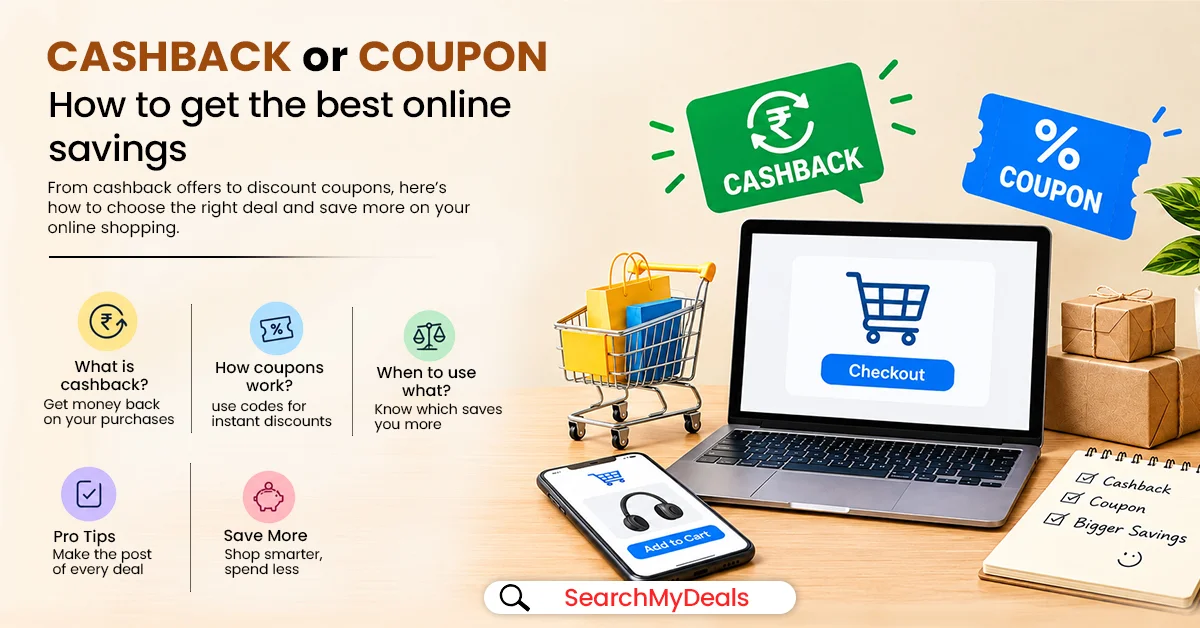
Online shopping makes it easy to compare prices, discover discounts, and find offers without leaving your home - but at the checkout page, there is always one question - should you use a coupon or cashback?
Both can reduce the effective cost of a purchase, but they work at different points. A coupon may reduce your bill right now, while cashback usually provides you a benefit after the purchase according to the offer's terms and eligibility requirements.
Which one is the better deal?
It depends on the product price, offer conditions, minimum order value, cashback rate, whether the offers can be combined, among other factors.
Let's explore the differences between cashback vs coupons and how to make better online shopping choices.
What Is a Coupon?
A coupon is a promotional code or offer that provides a discount or a different type of benefit when you purchase an eligible item.
For example, you may find a coupon offering 10% off on orders above Rs. 1,500.
If your eligible purchase was Rs. 2,000, the coupon could reduce your purchase price by Rs. 200, considering all offer's terms and conditions.
Coupons can have different types of benefits including percentage off, flat discount, first order offers, category specific discounts, bank / payment offers, free shipping benefits, buy-one-get-one offers, minimum-order discounts.
percentage off, flat discount, first order offers, category specific discounts, bank / payment offers, free shipping benefits, buy-one-get-one offers, minimum-order discounts
The main benefit of a coupon is that, in many cases, you will visibly see how much you save during the checkout moment.
What Is Cashback?
A cashback offer is one that provides you with a benefit after completing an eligible purchase.
For instance, an offer may offer you 5% cashback on a eligible purchase. If you purchased goods with an eligible value of Rs. 2,000, you could potentially receive up to Rs. 100 cash back, depending on the conditions and eligibility criteria on the offer.
Depending on the cashback program you chose, the benefits can be transferred to
a wallet, a rewards account, a bank account, a payment account, a loyalty account
a wallet, a rewards account, a bank account, a payment account, or a loyalty account.
Cashbacks may also depend on a number of other conditions such as maximum reward, minimum purchase requirement, tracking requirements, and time for the reward to be available.
It's always important to check the eligibility criteria of the cashback instead of only relying on the cashback percentage.
| Feature | Coupon | Cashback |
| When you benefit | Usually during checkout | Usually after the purchase |
| How it works | Reduces eligible purchase cost | Provides a reward after an eligible transaction |
| Saving visibility | Usually visible on the order total | May appear later |
| Common requirement | Coupon code or eligible offer | Activation/tracking and qualifying purchase |
| Minimum purchase | May apply | May apply |
| Maximum benefit | May apply | May apply |
| Availability | Depends on retailer and campaign | Depends on cashback program/offer |
| Best for | Immediate discount | Additional post-purchase reward |
Instant Savings vs Post Purchase
This is arguably one of the biggest differences between coupons and cashbacks that you need to be considerate of.
Instant Savings
Say you want to purchase a Rs. 3,000 item and find a Rs. 300 coupon.
Your Rs. 3,000 purchase becomes: Rs. 3,000 − Rs. 300 = Rs. 2,700
The bottom line is you pay less on a per-transaction basis and know the exact amount during your checkout.
Post Purchase
On the other hand, you can see the power of a post-purchase program when you receive a 10% cashback when you buy a Rs. 3,000 item.
The final cashback amount would be: Rs. 3,000 x 10% = Rs. 300
but the initial purchase price would be Rs. 3,000. Depending on the program's conditions, you could get up to Rs. 300.
It seems similar in value to the one shown in the first example but, you need to analyse more criteria when you make a choice between cashbacks and coupons.
What's Better - Cashback or Coupon?
There isn't really a right or a wrong answer to the question in the title.
In fact, you should compare which product or service will result in a bigger monetary benefit to you when analysing the potential deal.
For example, say you see these two offers and cannot use them together:
Option A (coupon): Rs. 4,000 item with a Rs. 500 discount
Final price: Rs. 3,500
Option B (cashback): Rs. 4,000 item with 10% cashback.
Potential cashback: Rs. 400
In this case, the monetary value of the coupon seems bigger since you would save Rs. 500 when compared to Rs. 400 of cashback.
However, everything changes if a different purchase is made:
Item: Rs. 5,000
Potential coupon: Rs. 250
Potential cashback: 10% = Rs. 500
Conditions are mutually exclusive for both offers.
If the product price and program conditions are met, the cashback offer provides you with more value. You should keep in mind that while percentages are a fair indicator for cashback, coupons usually list a flat value for the eligibility volume.
Another consideration should be:
- maximum cashback rewards
- minimum purchase requirements
- eligible items
- eligible payment methods
- cashback validity
- time for processing the payout
- excluded items
- does it apply to cancelled items or returns
A 20% cashback offer with a maximum of Rs. 100 is much more value-oriented than a coupon for a Rs. 500 discount.
When Is A Coupon More Useful?
Coupons can still be very useful to you when you want an immediate and predictable decrease in the final price.
It can be a smart decision to use a coupon if:
- The discount is significant.
- You wanted to reduce your purchase price immediately.
- The cashback had a max cap.
- The cashback had complicated eligibility requirements.
- The cashback is not something you wanted to wait for.
- The coupon offer was on a specific item or order.
- The benefit fits a short-term budget plan.
For instance, the Rs. 500 coupon for a Rs. 3,000 purchase can be easy to estimate than a cashback with a series of eligibility constraints.
Can You Use A Coupon and Cashback Together?
It's sometimes possible but it all depends on the retailer, cashback program, payment methods, and coupon offer.
The combination is always up to the seller unless otherwise stated.
Some retailers do allow cashback and coupon, while others explicitly state:
- only one promotional code can be used per order.
- cashback is unavailable for orders with another type of promotion.
- specific coupons do not allow cashbacks
- certain payment methods are needed.
- cashback applies only for a final eligible amount and many other conditions.
What About Bank and Payment Offers?
Online shopping can involve more than one type of discount. You can see coupons, cashbacks, credit card discounts, debit card offers, upi promotions, wallet rewards, loyalty points, and seller discounts.
coupons, cashbacks, credit card discounts, debit card offers, upi promotions, wallet rewards, loyalty points, seller discounts
That can make the final calculation very confusing.
For instance, a product can have a coupon along with a bank offer, but, the discount will probably only apply to the amount of the purchase that did not apply any other discount.
The best approach is to check the terms and conditions before choosing any of these offers and try to estimate how much you will be charged and how much additional cashback or coupon value you will receive. Don't sum up all the percentage values offered for one product.
How To Compare Online Offers
Before purchasing something, perform these steps.
Step 1: Check the Product Price
Step 2: Look for Available Coupons
Step 3: Look for Cashback Opportunities
Step 4: Read the Terms
Look for:
Minimum order value
Maximum values allowed
Eligible categories
Payment requirements
Expire dates
Exclusions
Step 5: Check if You Can Stack
If you can combine any of the offers, make a proper combination. If no, make a comparison.
Step 6: Calculate Final Benefit
Use a Deal Discovery Portal Before Your Purchase
It can take a big amount of time in your search engine trying to find a coupon or a cashback for each product you want. This is where a deal discovery portal comes in handy, as it shows you available coupons and cashbacks for all products you wish to buy - you don't need to search them one by one anymore.
For instance, before your buying a product you can check all the following, depending on the features available on the platform:
An available coupon
A cashback opportunity
A current promotional deal
Better price options
Alternative offers.
While the purpose isn't to pick the one with bigger discount, it's to compare all the available ones before purchase. A few minutes invested can prevent you from disappointments.
Cashback and Coupons - What Should You Look After
Before applying any of the offers check on these factors:
For coupons:
Coupon eligibility
Applies to your item?
Minimum order value
Maximum discount available
Stack able?
Applies to items on sale?
For cashbacks:
Activation requirements?
Purchase eligibility?
Eligible items?
Cashback maximums?
Time for rewards
Payment methods? Exclusions?
What if I return the item?
Final Thoughts
So, cashback or coupon – which should you choose?
There's no final winner between cashbacks and coupons. A coupon can prove very useful when you want a quick and predictable savings at your checkout. On the other hand cashbacks are appealing when the percentage is very attractive and its offers' conditions are convenient.
And finally on the possibility of combining cashback and coupons - if the retailers lets you to do so, make it.
The simplest strategy for making smart savings is: check the price find coupons analyse cashbacks look at terms check if coupons and cashbacks can be combined calculate final benefit.
A deal search platform such as this one can make it easy for you compare coupons and cashback offers in your search, saving you time, hassle and frustration as opposed to searching for coupons and cashbacks around different sites.
Frequently Asked Questions: Cashback vs Coupon
1. What is the difference between cashback and a coupon?
A coupon usually provides an immediate discount on an eligible purchase, while cashback generally provides a reward after the purchase is completed. The actual value depends on the offer's terms, limits, and eligibility requirements.
2. Is cashback better than a coupon?
Neither is always better. A coupon may provide greater immediate savings, while cashback can offer more value when its reward rate is higher and the purchase meets all eligibility conditions. Comparing the actual benefit is more useful than comparing percentages alone.
3. Can I use a coupon and cashback together?
Sometimes. Whether a coupon and cashback can be combined depends on the retailer and the specific offer terms. Some promotions allow multiple benefits, while others may exclude cashback when a coupon or another promotional discount is used.
4. How does cashback work when shopping online?
Cashback generally involves completing an eligible purchase through a qualifying offer or platform. After the transaction is verified, the cashback may be credited to a wallet, rewards account, bank account, or another eligible payment method, depending on the program.
5. How do online coupon codes work?
An online coupon code is entered during checkout to receive an eligible discount or benefit. Coupon codes may have conditions such as a minimum order value, expiry date, eligible products, or a maximum discount.
6. What is the difference between instant discount and cashback?
An instant discount reduces the amount you pay at checkout. Cashback generally provides a reward after the purchase. For example, a Rs. 500 coupon could reduce a Rs. 3,000 order to Rs. 2,500 immediately, while cashback may require you to pay the qualifying amount first and receive the reward later.
7. Should I choose a coupon or cashback when both are available?
Compare the actual monetary benefit of each offer. Check the discount or cashback amount, maximum limits, minimum order value, eligibility requirements, and whether the reward can be used in a way that is useful to you.
8. Does a higher cashback percentage always mean bigger savings?
No. Cashback offers may have maximum reward limits. For example, a 20% cashback offer capped at Rs. 100 could provide less value than a Rs. 300 coupon, depending on the purchase price and eligibility conditions.

Swati Rani
Author & EditorContent Author and Editor at SearchMyDeals.
View all articles by Swati Rani →


